- Why B2B Contact Data Goes Stale Faster Than You Think
- What B2B Contact Enrichment Actually Includes
- Single-Source vs. Waterfall Enrichment
- Data Enrichment vs. Data Cleansing
- How Enrichment Connects to Deal Outcomes
- Where Enrichment Breaks Down in Practice
- Automating Enrichment Across the Full Meeting Workflow
- Building an Enrichment Strategy That Holds Up
- FAQs
- The Bottom Line
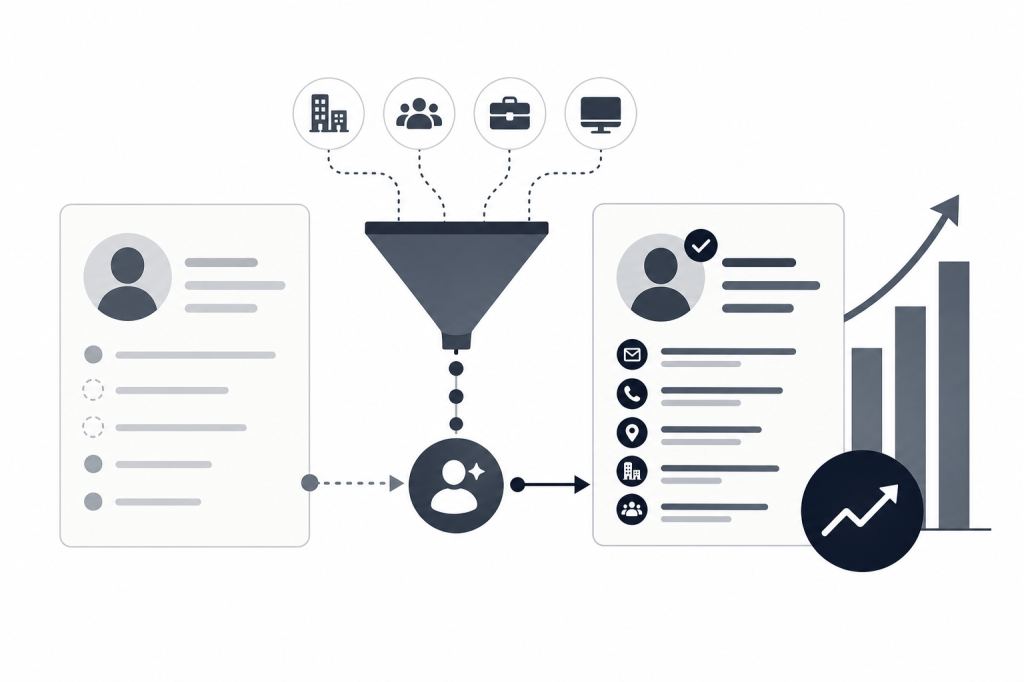
B2B contact enrichment is the practice of filling out incomplete contact and company records with verified data pulled from external sources — and it has a direct line to whether your deals close. Walking into a meeting with a half-empty CRM record doesn't just leave you underprepared. It means you're working with data that may already be wrong.
This article covers what contact enrichment actually means, why data decay makes it a continuous problem rather than a one-time fix, and how building richer profiles across the full meeting workflow changes what you're able to do in a conversation.
Why B2B Contact Data Goes Stale Faster Than You Think
People change jobs. Companies pivot. Titles get reorganized. Contact data doesn't update itself.
According to Cleanlist's 2026 research, B2B contact data decays at a rate of 2.1% per month — which compounds to roughly a 22.5% annual accuracy loss across your database. For a firm running 50 active relationships in HubSpot, that's 11 contacts with meaningfully outdated information by the end of the year.
The decay rate isn't uniform across geographies either. The B2B Data Index found that U.S. contact records experience the highest geographic decay rate, at 26% to 31% annually. If your pipeline is North America-heavy, your data is degrading faster than the global average.
The downstream effect lands squarely on your team's time. Landbase's 2026 analysis found that sales representatives lose approximately 500 hours per year — equivalent to 62 working days — validating and correcting contact information. That's not time spent on deals. That's time spent on data hygiene that enrichment could largely automate.
What B2B Contact Enrichment Actually Includes
Enrichment isn't a single data type. A complete enrichment strategy pulls from several layers.
Firmographic data covers the basics: company size, industry, revenue range, headquarters location, and funding stage. This is the minimum context you need before any first meeting.
Technographic data tells you what tools a company actually uses — their CRM, their marketing stack, their infrastructure. Knowing a prospect runs HubSpot before you walk in is a different kind of preparation than knowing their headcount.
Demographic and role data covers the individual: title, seniority, reporting structure, tenure at the company. A VP of Finance who joined six months ago has different priorities than one who's been in the seat for four years.
Intent data captures behavioral signals — content consumption, search patterns, competitor research activity — that indicate where a contact is in a buying cycle. This layer is harder to source but changes the timing of your outreach.
Relationship history is the layer most enrichment tools ignore entirely. What did you discuss on the last call? What did they commit to? What was the tone of the last email thread? For relationship-driven professionals, this context often matters more than any firmographic field.
Single-Source vs. Waterfall Enrichment
Most enrichment tools pull from one primary data source. The problem is that no single provider has complete coverage across all industries, geographies, and company sizes.
Waterfall enrichment runs a contact through multiple data sources in sequence, filling gaps that the first source missed. Landbase's 2026 data shows waterfall strategies achieve find rates of 85% to 95%, compared to 50% to 60% for single-source platforms. That gap in coverage is the difference between entering a meeting with a complete profile and entering with a record that's half empty.
If your enrichment strategy depends on one data provider, you're leaving a significant portion of your contacts under-enriched by default.
Data Enrichment vs. Data Cleansing
These two terms get conflated, but they solve different problems.
Data cleansing removes or corrects records that are wrong — bounced emails, duplicate entries, outdated phone numbers. It's a hygiene function. It makes your existing data accurate.
Data enrichment adds what isn't there — new fields, deeper context, external signals. It makes your existing data more useful.
You need both, but in the right order. Enriching dirty data without cleansing it first means building richer profiles on top of records that are already wrong. Clean first, enrich second, then establish a cadence to keep both current.
How Enrichment Connects to Deal Outcomes
Richer profiles change what you can do in a conversation. When you know a contact's recent job change, their company's funding stage, and what you discussed with them six months ago, you're not starting from scratch — you're continuing a relationship.
According to connectsafely.ai's 2026 analysis, enriched leads demonstrate a conversion rate improvement of 20% to 30% compared to raw leads. That gap exists because enriched outreach is specific. Generic outreach, built on incomplete records, reads as generic — and gets treated accordingly.
For PE and VC professionals, this dynamic is amplified. A portfolio review, an LP update call, or a first meeting with a potential co-investor carries relationship stakes that a transactional sales call doesn't. Walking in without context isn't just inefficient. It signals to the other person that you didn't prepare.
Where Enrichment Breaks Down in Practice
The problem usually isn't that professionals don't understand the value of enriched contact data. The problem is execution.
Most enrichment workflows require someone to manually pull from LinkedIn, check Crunchbase, review the last email thread, and cross-reference the CRM before a meeting. That takes 20 to 40 minutes per contact. For a firm running three to five meetings per day, that's a significant daily overhead — and it's exactly the kind of task that gets skipped when the calendar is full.
The other failure point is the post-meeting loop. Even when a meeting goes well, the context from that conversation often never makes it back into the CRM. Notes stay in a notebook or a personal doc. Follow-up emails get written from memory. HubSpot stays empty. The enrichment you had going into the meeting doesn't compound into anything useful for the next one.
Automating Enrichment Across the Full Meeting Workflow
This is where purpose-built tooling changes the economics. Rather than treating enrichment as a pre-meeting research task you do manually, the better approach is to automate it as a background process tied to your calendar.
Baxter is built specifically for this workflow. It connects to your calendar, email, and HubSpot, then automatically pulls enrichment data from 12 or more external sources — including LinkedIn and Crunchbase — alongside internal signals from Gmail and Slack. Before a meeting, you get a briefing. During the meeting, it records and transcribes. After the meeting, it drafts follow-up emails and syncs notes, tasks, and tags back to HubSpot automatically.
The AI agent runs in the background without requiring manual prompts. You don't configure it before each meeting — it runs on its own, which means enrichment happens whether or not you had time to prep.
For relationship-driven professionals at PE, VC, and boutique advisory firms, this covers the specific failure modes that matter most: incomplete pre-meeting context, lost post-meeting notes, and a CRM that never reflects what actually happened in the conversation.
Building an Enrichment Strategy That Holds Up
A few principles that separate enrichment programs that work from ones that quietly decay:
Use multiple sources. Single-source enrichment leaves too many gaps. Pulling from LinkedIn, Crunchbase, and internal tools in combination gives you coverage that no one provider can match alone.
Tie enrichment to workflow triggers. Enrichment that runs on a quarterly schedule is less useful than enrichment that fires when something changes — a new meeting scheduled, a contact's title updated, a company announcing a funding round.
Close the post-meeting loop. Enrichment isn't just about what you know going in. It's about capturing what you learned coming out. Meeting notes, commitments made, tone of the conversation — these are enrichment data points that only exist inside your workflow.
Keep the CRM current. Enrichment that lives in a briefing doc but never reaches your CRM doesn't compound. Every piece of context that gets captured and synced makes the next meeting better.
Treat data decay as ongoing, not solved. A one-time enrichment pass has a shelf life. Given that U.S. contact records decay at 26% to 31% annually, a database you enriched 12 months ago is already meaningfully degraded. Enrichment needs to be a continuous process, not a project.
FAQs
What is B2B contact enrichment?
B2B contact enrichment is the process of adding verified external data to existing contact and company records. This includes firmographic details like company size and funding stage, technographic data about the tools a company uses, demographic information about individuals, and behavioral signals that indicate buying intent.
How fast does B2B contact data decay?
According to Cleanlist's 2026 research, B2B contact data decays at approximately 2.1% per month, which translates to roughly 22.5% annual accuracy loss. U.S.-based records decay faster — the B2B Data Index found rates of 26% to 31% annually for contacts in the United States.
What is waterfall enrichment and why does it matter?
Waterfall enrichment runs a contact through multiple data sources in sequence, using each provider to fill gaps the previous one missed. Landbase's 2026 data shows waterfall strategies achieve find rates of 85% to 95%, compared to 50% to 60% for single-source approaches. The difference in coverage is significant for any firm managing a large contact database.
How does contact enrichment affect conversion rates?
Enriched leads show a 20% to 30% improvement in conversion rates compared to raw leads, according to connectsafely.ai's 2026 analysis. Richer profiles enable more specific, relevant outreach, which consistently outperforms generic messaging built on incomplete data.
What is the difference between data enrichment and data cleansing?
Data cleansing corrects or removes inaccurate records — bounced emails, duplicates, outdated entries. Data enrichment adds new information to existing records. Both are necessary, but cleansing should happen before enrichment to avoid building richer profiles on top of already-wrong data.
How many hours do sales reps lose to bad contact data?
Landbase's 2026 analysis found that sales representatives lose approximately 500 hours per year — around 62 working days — validating and correcting contact information. Automated enrichment reduces this overhead significantly by keeping records current without manual intervention.
Can AI tools automate B2B contact enrichment?
Yes. Tools like Baxter pull from 12 or more external sources including LinkedIn and Crunchbase, alongside internal integrations like Gmail and HubSpot, to automatically enrich contact profiles before meetings. The AI agent runs in the background without requiring manual prompts, handling enrichment, briefing, and CRM sync as part of a continuous workflow rather than a one-time task.
The Bottom Line
B2B contact enrichment isn't a data project. It's a competitive advantage that compounds over time — or erodes if you ignore it. Every meeting you walk into with a complete, current profile is a meeting where you can focus on the relationship instead of reconstructing context in real time.
The firms that win more deals aren't necessarily better at selling. They're better prepared. And preparation, at scale, requires automation. If you're spending 30 to 60 minutes per meeting on manual research that could run in the background, that time is costing you something. Learn more at joinbaxter.com.


Leave a Reply