- What Deal Intelligence Actually Means
- Why Most Pipelines Have a Deal Intelligence Gap
- The Three Stages Where Deal Intelligence Breaks Down
- What Good Deal Intelligence Looks Like in Practice
- How AI Changes the Deal Intelligence Equation
- Deal Intelligence for PE, VC, and Relationship-Driven Firms
- What to Look for in a Deal Intelligence Tool
- Frequently Asked Questions
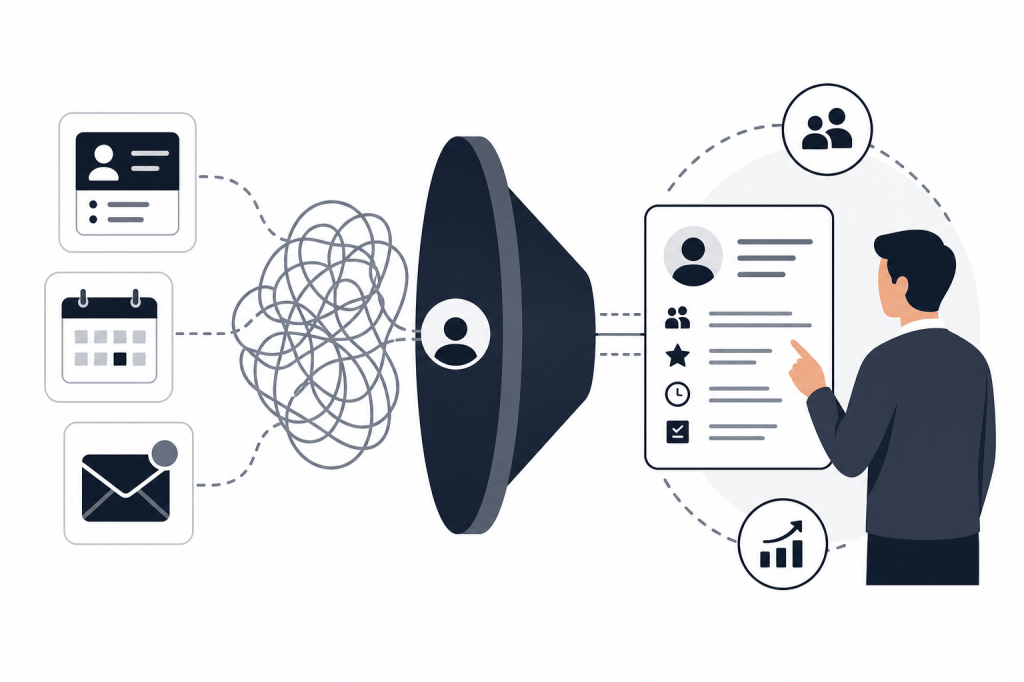
Deal intelligence is the practice of gathering, connecting, and acting on every signal that surrounds a deal — who the people are, what they care about, what your history with them looks like, and what context you need before you walk into a room with them. If your pipeline has ever stalled because a follow-up slipped, a contact changed jobs without anyone noticing, or a meeting happened but the notes never made it to your CRM, that is a deal intelligence problem.
This article explains what deal intelligence means in practice, why it matters more than a tidy spreadsheet of contacts, and how modern AI tools are changing the way relationship-driven professionals manage it.
What Deal Intelligence Actually Means
Deal intelligence is not a single feature or a single data source. It is the complete picture of a deal at any given moment: the people involved, the company context, the relationship history, and the next action required.
Think of it in three layers.
Contact and company context. Who are you meeting? What has their firm done recently? Have they raised capital, changed leadership, or published anything worth knowing? This layer is built from external sources — LinkedIn profiles, Crunchbase funding data, news, firmographic signals — combined with what you already know from your own email and calendar history.
Relationship history. How many times have you spoken? Who made the introduction? When did you last follow up, and what did you say? This is the layer most teams lose track of first, because it lives scattered across inboxes, calendar entries, and CRM records that rarely stay in sync.
Next-action clarity. What needs to happen after this conversation? Who drafts the follow-up? Does the CRM get updated? Is there a new contact worth adding to a prospect list? This is where most deal context dies — not because people forget, but because the admin overhead of capturing it competes directly with the time needed to make the next call.
When all three layers are working, you walk into every meeting prepared, you leave with the right actions already in motion, and nothing falls through the gap between the conversation and the CRM.
Why Most Pipelines Have a Deal Intelligence Gap
The gap is rarely a technology problem. Most firms already have a CRM, a calendar, and some version of a note-taking habit. The problem is that these tools do not talk to each other automatically — and the person who carries the relationships, a Partner, a Principal, a founder, is also the person responsible for keeping them in sync.
That creates a specific kind of drag. Before a meeting, there is no time to pull LinkedIn, Crunchbase, and email history together, so you go in with partial context. During the meeting, notes happen informally or not at all. After the meeting, the follow-up email sits in drafts while you move to the next call, and the CRM update gets pushed to the end of the week, then the end of the month.
The result is a pipeline that looks full but feels fragile. Deals that should close get delayed because a follow-up was late. Relationships that should deepen go cold because no one noticed the last touchpoint was six months ago.
For teams of five to fifty people — PE and VC firms, boutique advisory shops, founder-led sales organizations — this is not a minor inefficiency. It is the primary reason deal velocity slows as volume grows.
The Three Stages Where Deal Intelligence Breaks Down
Before the Meeting
Pre-meeting research is where deal intelligence should start, and where it is most often skipped. Not because it is unimportant, but because pulling together a useful briefing from LinkedIn, Crunchbase, your CRM, and your email history takes time that most deal professionals simply do not have between back-to-back calls.
So you rely on memory and whatever you can scan in the two minutes before the meeting starts. That is not a briefing. It is improvisation.
Effective pre-meeting deal intelligence means knowing the person's current role and recent activity, understanding the company's funding stage or recent news, and having your own relationship history in front of you — last contact, last topic, any open commitments. That context changes the quality of the conversation before you say a word.
During the Meeting
The meeting itself is where deal intelligence should be captured, not reconstructed afterward. But most note-taking is either manual and incomplete, or automated in a way that produces a transcript no one reads.
What matters is not a verbatim record. It is the signal inside the conversation: what the other person said they needed, what you committed to, what follow-up was implied. That signal needs to be captured in a form that is actually useful the next time you open the CRM record — not buried in a forty-minute transcript.
After the Meeting
Post-meeting is where deal intelligence most visibly fails. The follow-up email does not get written, or it gets written three days later when the conversation has gone cold. The CRM record does not get updated, or it gets updated with a note that says "good call" and nothing else. The prospect list that should have come out of the conversation never gets started.
This is not a discipline problem. It is a capacity problem. When the same person who runs the meeting is also responsible for all the post-meeting admin, something gets cut — and it is usually the admin.
What Good Deal Intelligence Looks Like in Practice
A deal professional with strong deal intelligence support looks different at every stage of the process.
Before a meeting, they receive a briefing they did not have to build — covering the contact's background, the company's recent activity, and the relationship history pulled from their own email and calendar. They walk in with context.
During the meeting, the conversation is captured without distraction. They are present, not transcribing.
After the meeting, the follow-up email is drafted, the CRM is updated, and any new contacts worth adding to a prospect list are already identified. The next action is clear and the admin is done.
None of that requires a research analyst. It requires a system that connects the right data sources and runs in the background without needing to be prompted.
How AI Changes the Deal Intelligence Equation
Deal intelligence has historically been expensive to maintain because it requires someone to do the connecting. Pulling external data, reconciling it with internal history, and turning it into a usable briefing is skilled work. So is drafting a follow-up that actually reflects what was said in the meeting.
AI changes this by doing the connecting automatically. An agentic AI system can pull from LinkedIn, Crunchbase, and news sources before a meeting starts, combine that with your email and calendar history, and deliver a briefing without any manual input. After the meeting, the same system can draft the follow-up, update the CRM, and flag new contacts for outreach.
The key word is agentic. A tool that waits for you to prompt it is still a research tool. A tool that runs in the background and delivers the output before you ask is an operating layer for your pipeline.
That distinction matters most for relationship-driven professionals. You do not want to manage the intelligence process. You want the intelligence to be there when you need it.
Deal Intelligence for PE, VC, and Relationship-Driven Firms
For firms where relationships are the product — PE and VC partnerships, boutique advisory practices, founder-led sales — deal intelligence has a dimension that generic sales tools miss.
It is not just about pipeline velocity. It is about relationship depth. The touchpoint history between a Partner and a founder matters. The strength of a relationship with an LP matters. The fact that you met someone at a conference two years ago and followed up once matters, even if it never became a formal deal.
Generic meeting note tools do not track this. They record what was said in a meeting, but they do not connect that to a relationship timeline, a contact profile built from external sources, or a score that tells you which relationships are warming and which are going cold.
Deal intelligence at this level requires something closer to a relationship operating system than a note-taker. It needs to connect external data with internal history, surface the right context at the right moment, and handle the post-meeting work that keeps relationships moving forward.
Baxter is built specifically for this use case. It connects to your calendar, email, and HubSpot CRM, pulls from over 12 external data sources including LinkedIn and Crunchbase, and runs as an agentic AI that delivers pre-meeting briefings, captures meetings, and handles post-meeting tasks without waiting for a prompt. The free plan includes CRM sync and the Baxter Intel Agent at no cost, so you can see how the full loop works before committing to a paid tier.
What to Look for in a Deal Intelligence Tool
When evaluating tools in this space, the right questions are not about features in isolation. They are about coverage across the full deal cycle.
Does the tool do anything before the meeting starts, or is it purely reactive? A tool that only records and transcribes is a note-taker, not a deal intelligence system.
Does it pull from external data sources, or only from what you have already entered into your CRM? External enrichment from LinkedIn, Crunchbase, and similar sources is what makes a briefing useful rather than redundant.
Does it handle post-meeting tasks automatically, or does it wait for you to configure outputs? The value of deal intelligence collapses if the follow-up still requires manual effort.
Does it integrate natively with your CRM, with two-way sync? Notes that push one way and never come back are not a CRM integration — they are a filing system.
And does it have a relationship layer, not just a deal layer? Contact timelines, relationship strength scores, and touchpoint history are what separate a deal intelligence tool from a sales productivity tool.
Frequently Asked Questions
What is deal intelligence?
Deal intelligence is the practice of gathering and connecting all the information that surrounds a deal: who the people are, what your relationship history with them looks like, what context exists before a meeting, and what actions are needed after it. It spans contact and company research, relationship history, and post-meeting follow-through.
How is deal intelligence different from CRM data?
CRM data is what you have already entered. Deal intelligence is what you need before, during, and after a conversation — including external signals like recent news, funding activity, and LinkedIn updates that your CRM does not capture automatically. The two work together when your deal intelligence system syncs its output back to the CRM.
Why do pipelines stall without deal intelligence?
Without deal intelligence, meetings happen without full context, follow-ups are delayed or skipped, and CRM records fall behind. The result is a pipeline that looks active but moves slowly because the relationship work that drives deals forward is not getting done consistently.
Do you need a large team to implement deal intelligence?
No. The firms that benefit most are often small — five to fifty people — because they carry high deal volume without the headcount to support a dedicated research function. AI tools that run in the background are specifically useful here because they replace analyst work without requiring analyst headcount.
What data sources matter most for deal intelligence?
LinkedIn for contact context, Crunchbase for company and funding data, news sources for recent activity, and your own email and calendar history for relationship context. The combination of external and internal sources is what makes a briefing genuinely useful rather than generic.
Is deal intelligence only relevant for sales teams?
No. It is equally relevant for PE and VC professionals managing LP relationships and portfolio reviews, boutique advisors managing client relationships, and any founder who personally carries key business relationships. The common thread is that relationships are central to outcomes, not just a support function.
How does an AI agent support deal intelligence?
An agentic AI system pulls from external and internal data sources automatically, delivers pre-meeting briefings without prompts, captures meetings, and handles post-meeting tasks like drafting follow-up emails and syncing notes to a CRM. The key difference from a standard AI assistant is that it acts without waiting to be asked.
Deal intelligence is not a new idea. Knowing your counterpart, keeping your relationship history current, and following up promptly have always been the fundamentals of relationship-driven work. What has changed is that the volume of information required to do those things well now exceeds what any individual can manage manually. The firms that move fastest in 2026 are the ones that have stopped trying to manage that information by hand.


Leave a Reply