- Why Post-Call Follow-Ups Deserve Their Own Playbook
- What a Strong Post-Call Follow-Up Actually Contains
- How AI Drafts the Follow-Up — and Where It Needs Your Help
- The Timing Question
- Personalization: What Actually Moves the Needle
- Reviewing AI-Generated Drafts Before You Send
- When Follow-Ups Aren't Working
- FAQs
- Make Every Call Count
The window right after a sales call is where deals are won or quietly lost. You have context, momentum, and a contact who just spent real time with you — and then most of that evaporates while you're writing notes, updating your CRM, and trying to remember what you promised to send. An AI follow-up email changes that equation, but only if it's built from the right inputs and edited with the right judgment.
This article covers post-call outreach specifically: what to include in a follow-up, how AI can draft it faster without making it sound robotic, and what separates an email that moves a deal forward from one that gets politely ignored.
Why Post-Call Follow-Ups Deserve Their Own Playbook
Most follow-up email advice is written for cold outreach sequences. That's useful, but a post-call follow-up is a different animal. You're not trying to get someone's attention for the first time. You're reinforcing a conversation that already happened, confirming next steps, and giving the contact a reason to stay engaged.
The stakes are different too. Cold email benchmarks from instantly.ai's 2026 analysis put the average reply rate at 3.43%, with top performers reaching 10.7% or above. Post-call follow-ups, when done well, should perform meaningfully above that baseline — because you have shared context that cold outreach simply doesn't.
The problem is that most post-call follow-ups are written under pressure. The call just ended, you have three more on the calendar, and you're trying to reconstruct what was said from memory. That's where AI becomes genuinely useful — not as a replacement for your judgment, but as a way to turn raw call data into a structured draft you can review and send quickly.
What a Strong Post-Call Follow-Up Actually Contains
Before thinking about AI, get clear on what the email needs to do. A follow-up that actually moves things forward typically includes:
A brief recap of what was discussed. Not a transcript dump — two or three sentences that show you were listening. Reference something specific the contact said, not just the agenda items you covered.
Confirmed next steps with ownership. If you said you'd send a model, name it. If they said they'd loop in their CFO, acknowledge it. Ambiguity here is where deals stall.
Any materials or resources you promised. If you mentioned a case study, a deck, or a specific data point, include it or link to it. Following through on small commitments builds the kind of trust that closes larger ones.
A clear, low-friction ask. This doesn't have to be "book a demo." It might be "does Thursday at 2pm work to continue this?" or "let me know if the deck raises any questions." The goal is to keep the thread alive.
A subject line that references the call. "Following up" is the weakest possible subject line. "Re: our conversation on [topic]" or "Next steps from today's call" gives the contact immediate context and a reason to open.
How AI Drafts the Follow-Up — and Where It Needs Your Help
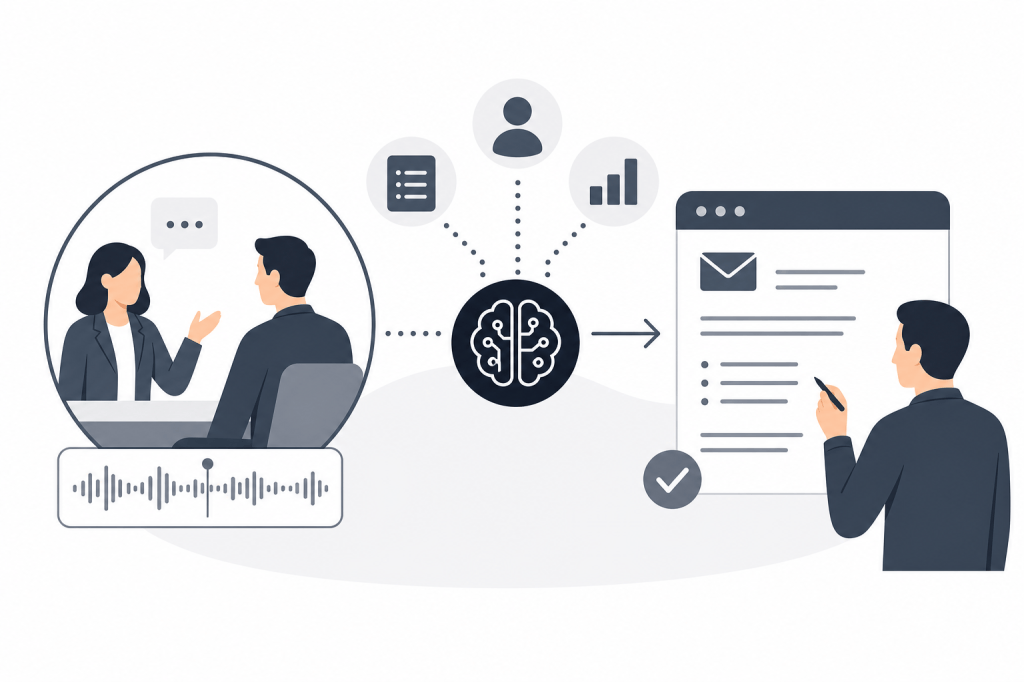
An AI follow-up email tool works by pulling from the call transcript, your notes, and whatever CRM context it has access to. Output quality depends almost entirely on input quality. A tool that only has a transcript will produce a generic summary. A tool that also has the contact's background, your email history, and what they said in a previous meeting can produce something that actually sounds like it came from someone who paid attention.
That gap matters. Most AI meeting tools are reactive: they record and transcribe, then let you copy-paste from the summary. The draft you get is usually accurate but flat — it reads like meeting minutes, not a relationship email.
A stronger approach is giving the AI the full picture before it drafts: who the contact is, what their company does, what your prior interactions looked like, and what you're trying to accomplish with this specific email. When those inputs are already assembled, the draft is far easier to edit into something worth sending.
Baxter is built around this idea. It connects to your calendar, email, and HubSpot, pulls from 12+ external data sources including LinkedIn and Crunchbase, and drafts follow-up emails after calls using that full context — not just the transcript. The AI agent runs in the background without manual prompts, so by the time the call ends, the draft is already being assembled from everything it knows about the contact and the conversation.
The Timing Question
For cold outreach, timing guidance varies. XtendedView's analysis of 7.53 million emails found that 58.6% of replies came from emails sent after the first step, with the third email in a sequence producing 35.6% of email-sourced meetings — a useful reminder that persistence matters in cold outreach.
Post-call follow-ups work differently. The best time to send is within a few hours of the call ending, ideally the same day. The conversation is fresh for both parties, your contact hasn't mentally moved on, and any action items are still top of mind. Waiting until the next morning is acceptable. Waiting three days is not.
If you promised to send something specific and haven't yet, send a short note acknowledging that and giving a timeline. Silence after a call reads as disorganization, even when it isn't.
Personalization: What Actually Moves the Needle
Generic AI follow-ups fail for the same reason generic cold emails fail: they don't say anything the contact couldn't have received from anyone. Personalization in a post-call context means referencing what was actually said — not just inserting a name and company into a template.
A few things that work:
- Reference a specific concern or question they raised, not just the general topic
- Acknowledge something they mentioned about their situation, timeline, or priorities
- Connect your follow-up materials to their stated problem, not just your product's features
- Match the tone of the conversation — if the call was informal, a stiff formal email feels jarring
AI can help with all of this when it has the right inputs. It can pull the contact's LinkedIn background, cross-reference what they said on the call, and surface the parts of the conversation most worth referencing. The draft still needs a human read before it goes out.
Reviewing AI-Generated Drafts Before You Send
This is the step most people skip, and it's the one that matters most. An AI draft is a starting point, not a finished product. Before you send, check for:
Accuracy. Did the AI correctly capture what was agreed? Summaries sometimes compress or reorder events in ways that shift the meaning. Read it as if you're the contact receiving it.
Tone. Does it sound like you? AI-written emails can be technically correct but feel impersonal. Add a sentence that reflects how the conversation actually felt.
Specificity. Are the next steps concrete? "We'll be in touch" is not a next step. "I'll send the overview by Friday and we can reconnect the week of the 29th" is.
Length. Post-call follow-ups should be short. Three to five sentences for the body, plus any attachments or links. If the AI draft is running long, cut it.
The goal is to get from raw draft to sent email in under five minutes. If you're spending longer than that editing, the draft wasn't good enough to start with — which usually means the inputs need to improve.
When Follow-Ups Aren’t Working
If your post-call follow-ups are getting low reply rates, the problem is usually one of three things: timing (you waited too long), specificity (the email could have been sent to anyone), or ask (you didn't make it clear what you wanted the contact to do next).
b2bdataindex.com notes that well-run B2B cold email campaigns in 2026 have a median reply rate of 4%, and campaigns falling below 1.5% should investigate copy, offer, and targeting. Post-call follow-ups should perform above that range because the relationship is already warm. If they're not, that's diagnostic information about what the call itself established — or didn't.
FAQs
What should an AI follow-up email include after a sales call?
A post-call AI follow-up should include a brief recap of what was discussed, confirmed next steps with clear ownership, any materials you promised to send, and a specific ask. The subject line should reference the call rather than defaulting to something generic like "following up."
How quickly should I send a follow-up email after a call?
Same day is best. Sending within a few hours keeps the conversation fresh and signals that you're organized. Waiting more than 24 hours reduces the impact, especially when action items were discussed.
What makes an AI-generated follow-up email sound authentic?
The quality of the inputs matters most. A draft built from the call transcript, the contact's background, and your prior email history will read more naturally than one built from a transcript alone. Always review and edit before sending to add your own voice and catch any inaccuracies.
How is a post-call follow-up different from a cold outreach email?
Cold outreach is trying to earn attention from someone who doesn't know you. A post-call follow-up is reinforcing a conversation that already happened. It should reference specifics from the call, confirm what was agreed, and move toward a defined next step — not re-introduce yourself.
Can AI tools draft follow-up emails automatically after every call?
Yes, when the tool has access to the call transcript, CRM context, and contact data. Tools like Baxter assemble the draft in the background using all three sources so you can review and send quickly rather than writing from scratch.
What's the biggest mistake people make with AI follow-up emails?
Sending the draft without editing it. AI-generated emails can be accurate but flat. A quick review to add specificity, adjust tone, and confirm that next steps are correct takes a few minutes and significantly improves how the email lands.
How many follow-up emails should I send after a call?
One well-written follow-up sent promptly is the priority. If you don't hear back, a single check-in a week later is reasonable. The persistence tactics that work in cold sequences don't map directly to post-call outreach, where the relationship context already exists.
Make Every Call Count
The hour after a meeting shouldn't be spent reconstructing what happened and writing emails from memory. When your AI follow-up email is built from the full context of the call — the transcript, the contact's background, your CRM history, and what you agreed on — it takes minutes to review and send rather than an hour to write.
That's the difference between a tool that records your meetings and one that helps you act on them. Learn more at joinbaxter.com.


Leave a Reply