- Why Your Meeting Agenda Template Matters More Than You Think
- The Core Sections Every Meeting Agenda Needs
- Meeting Agenda Template by Meeting Type
- The Prep Work That Makes Your Agenda Actually Work
- Post-Meeting: Closing the Loop Your Agenda Opened
- Common Mistakes to Avoid
- A Simple Meeting Agenda Template You Can Use Today
- FAQs
- Make Every Meeting Count
A solid meeting agenda template looks simple on paper but makes an enormous difference in practice. Whether you're running a first call with a prospective LP, a portfolio company check-in, or an internal deal review, the structure you bring shapes what actually gets decided — and what happens afterward.
This guide covers what belongs in every agenda, how to adapt it for different meeting types, and where most professionals lose time before and after the meeting itself.
Why Your Meeting Agenda Template Matters More Than You Think
Most meetings fail before they start. Someone joins without context, the conversation meanders, and the last five minutes become a scramble to figure out next steps. A well-built agenda prevents that.
But a template isn't just a list of topics. It signals to everyone in the room that you've done the work, you respect their time, and you have a clear outcome in mind. For relationship-driven professionals — founders carrying key accounts, deal partners managing active pipelines, advisors juggling multiple LP relationships — that signal matters.
The right structure also makes post-meeting follow-through easier. When you know what you planned to cover, you can quickly see what got resolved, what got deferred, and who owns what next.
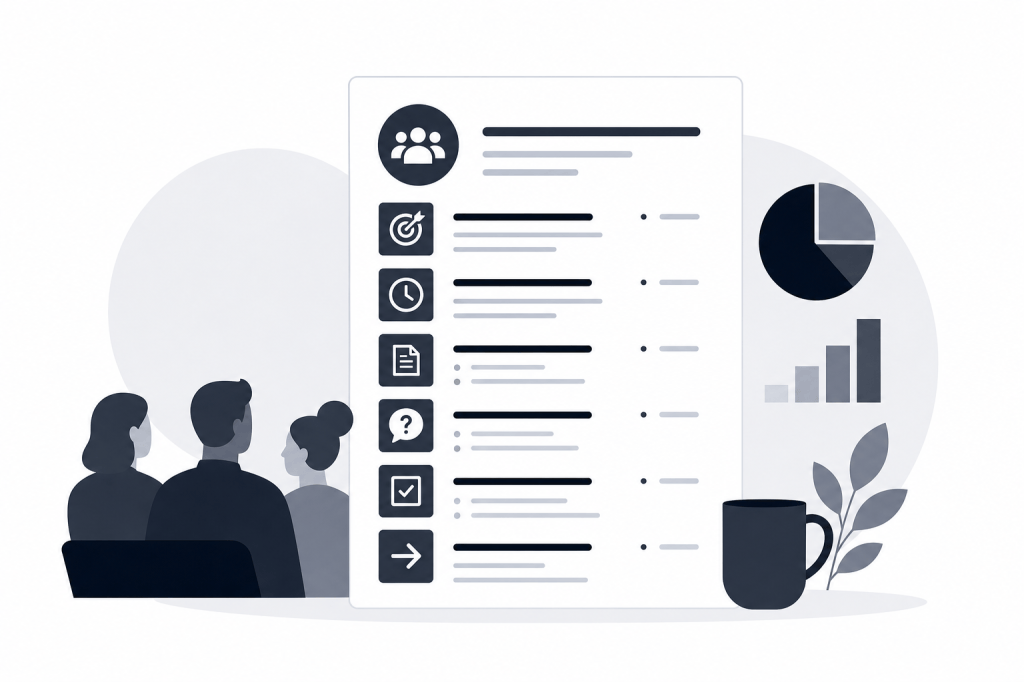
The Core Sections Every Meeting Agenda Needs
Regardless of meeting type, a strong agenda includes the same foundational elements. Here's what to build in every time.
1. Meeting Purpose (One Sentence)
State the goal in a single sentence at the top. Not the topics, not the background — just the outcome you're aiming for.
Examples:
- "Align on Q3 portfolio company priorities before the LP update call."
- "Decide whether to move forward with the term sheet."
- "Introduce the firm and understand the founder's current capital needs."
This keeps everyone oriented. If the conversation drifts, you can point back to the stated purpose and redirect.
2. Attendees and Roles
List who's joining and, where relevant, why they're there. On a deal call, note who's leading versus observing. On an internal meeting, note who owns each agenda item.
It sounds obvious, but it prevents the common problem of someone sitting through a 45-minute call that only needed them for five minutes.
3. Time Allocation Per Topic
Assign time blocks to each item — not because you'll follow them rigidly, but because it forces prioritization. If you have 30 minutes and five topics, you can't give each one equal weight. Deciding in advance which topics get 10 minutes and which get two is a form of judgment that improves the meeting before it starts.
A simple format works fine:
| Topic | Owner | Time |
|---|---|---|
| Context and introductions | You | 5 min |
| Current situation overview | Counterpart | 10 min |
| Key questions / discussion | Both | 10 min |
| Next steps | You | 5 min |
4. Background and Context
Include a brief section with any context attendees need before the meeting — a summary of the last conversation, a relevant document link, or a few bullet points on the company or person you're meeting.
This section gets skipped most often because it takes time to prepare. That's exactly why it matters. Professionals who consistently show up with context earn trust faster than those who ask questions they could have answered beforehand.
5. Key Questions to Address
List the specific questions you want answered by the end of the meeting. These are different from agenda topics. A topic is "portfolio company update." A question is "Has the company hit its Series B milestones, and if not, what's the revised path?"
Questions keep the meeting productive even when conversation wanders. You can always return to the list and check what's still open.
6. Decisions Required
If the meeting needs to produce a decision, name it explicitly. "By the end of this call, we need to decide whether to proceed with due diligence" is clearer than "due diligence discussion" as a topic.
Named decisions also make it easier to close meetings. When the decision is written down, you can confirm it out loud before ending the call rather than leaving with vague alignment.
7. Next Steps Format
Reserve the last few minutes of every meeting for next steps. Your agenda should include a placeholder for this with a consistent format: action item, owner, deadline.
The meeting isn't done until next steps are captured. Building this into the template means it never gets skipped.
Meeting Agenda Template by Meeting Type
The core structure above applies universally, but the content within each section shifts depending on the meeting.
First Introductory Call (Prospect or LP)
Purpose: Understand their situation and determine if there's a fit worth exploring further.
What to include:
- Brief firm overview (two to three minutes, not a pitch)
- Questions about their current situation, goals, and timeline
- Space for them to ask about you
- A clear close: what's the logical next step if there's mutual interest?
The background section here should include everything you've gathered on the person and their firm before the call — recent news, funding history, LinkedIn activity, any prior touchpoints. Walking in without this context is a missed opportunity.
Deal Review or Investment Committee Meeting
Purpose: Reach a decision or clear next steps on a specific deal.
What to include:
- Deal summary and current status
- Key diligence findings to date
- Open questions and risks
- Decision required: pass, proceed, or return with more information
- Owner for each open item
These meetings benefit from a tight agenda because they often involve multiple senior people with limited time. Every minute spent on background that should have been pre-read is a minute taken from actual deliberation.
Portfolio Company Check-In
Purpose: Track progress against plan, surface problems early, and agree on support needed.
What to include:
- Metrics review against last period's targets
- What's working and what isn't
- Specific asks from the company (introductions, resources, advice)
- Firm's asks or updates
- Next check-in date and owner
Internal Team Meeting
Purpose: Varies, but usually alignment, decision-making, or information sharing.
What to include:
- Only items that require real-time discussion (push everything else to async)
- Decision owner for each item
- Time boxes to prevent any one topic from consuming the meeting
- A clear distinction between "for decision" and "for information" items
The Prep Work That Makes Your Agenda Actually Work
A template is only as good as the information you put into it. The background and context section, in particular, requires real research if it's going to be useful.
For most deal professionals, that means pulling LinkedIn profiles, checking recent Crunchbase funding rounds, reviewing prior email threads, and scanning internal notes from previous conversations. Done manually, that takes 30 to 60 minutes per meeting. At high volume, it simply doesn't get done.
This is where Baxter changes the workflow. Rather than manually assembling context before each call, Baxter's AI agent pulls from 12+ external data sources — including LinkedIn and Crunchbase — alongside internal tools like Gmail and Google Calendar to build contact and company profiles automatically. The briefing is ready before the meeting starts, without requiring you to prompt it.
That means the background section of your agenda gets filled in without the 45-minute research sprint. You walk in with context, the conversation is better, and the relationship moves faster.
Post-Meeting: Closing the Loop Your Agenda Opened
An agenda sets up the conversation. What happens after determines whether it was worth having.
The most common failure point is next steps. They get agreed on verbally, nobody writes them down, and three days later nobody remembers who was supposed to do what. Your agenda template should make it easy to capture next steps in a consistent format during the meeting — not after.
Post-meeting, those next steps need to move somewhere actionable: a CRM record, a task list, a follow-up email. The professionals who do this consistently are the ones whose relationships actually compound over time.
Automating that handoff is increasingly practical. When meeting notes, tasks, and follow-up drafts sync directly to HubSpot without manual entry, the gap between "agreed in the meeting" and "logged and acted on" shrinks to near zero.
Common Mistakes to Avoid
Too many topics for the time available. If you have 30 minutes, three focused agenda items will produce better outcomes than seven rushed ones.
No stated purpose. Listing topics without naming the goal means the meeting can end without anyone knowing whether it succeeded.
Skipping the background section. Showing up without context signals that you didn't prepare — and means you spend meeting time on catch-up that should have happened beforehand.
No decision owner. Discussions without a named decision-maker tend to end inconclusively. Name the person who will make the call.
Next steps left to memory. If next steps aren't written down during the meeting, they don't exist. Build the capture step into the agenda itself.
A Simple Meeting Agenda Template You Can Use Today
Here's a clean, reusable format you can adapt for most professional meetings:
Meeting: [Name or deal/company]
Date: [Date]
Attendees: [Names and roles]
Purpose: [One sentence]
Background
- [Key context, last conversation summary, relevant news]
Agenda
| # | Topic | Owner | Time |
|---|---|---|---|
| 1 | Introductions / context | [Name] | 5 min |
| 2 | [Main topic 1] | [Name] | [X] min |
| 3 | [Main topic 2] | [Name] | [X] min |
| 4 | Open questions | Both | [X] min |
| 5 | Next steps | [Name] | 5 min |
Key Questions to Answer
- [Question 1]
- [Question 2]
- [Question 3]
Decision Required
[State the decision clearly, or write "None — alignment meeting"]
Next Steps
| Action | Owner | Due |
|---|---|---|
| [Action] | [Name] | [Date] |
Copy it, adapt the sections to your meeting type, and fill in the background before every call. The consistency compounds.
FAQs
What should always be in a meeting agenda template?
Every agenda should include a stated purpose, attendees and their roles, time allocations for each topic, relevant background context, key questions to address, any decisions required, and a next steps section. These seven elements apply regardless of meeting type.
How long should a meeting agenda be?
For most professional meetings, one page or less. The goal is orientation, not documentation. If your agenda requires multiple pages to explain context, that context probably belongs in a pre-read document that attendees review before joining.
How far in advance should you send a meeting agenda?
At least 24 hours before the meeting. For high-stakes calls like investment committee reviews or LP updates, 48 to 72 hours gives attendees time to review background materials and come prepared with informed questions.
What's the difference between an agenda topic and a key question?
A topic is a subject area ("portfolio company update"). A question is the specific thing you need to resolve ("Has the company hit its Series B milestones, and if not, what's the revised path?"). Questions produce better meetings because they give the conversation a clear endpoint.
How do you handle meetings where the agenda gets ignored?
Start with a brief agenda review. State the purpose out loud, confirm the time available, and flag which items are highest priority. It doesn't guarantee the agenda gets followed, but it raises the odds significantly and gives you a natural way to redirect when the conversation drifts.
Should you include background research in the agenda itself?
A brief summary of relevant context belongs in the agenda. Detailed research is better as an attachment or pre-read. The background section should give attendees enough to walk in prepared — not overwhelm them with information they won't read.
Can AI tools help with meeting agenda preparation?
Yes. Tools that pull from external data sources and internal communication history can automate the background and context section, which is typically the most time-consuming part to prepare. Rather than manually researching LinkedIn profiles, funding history, and prior email threads, an AI agent can assemble that context before the meeting starts — so the agenda is ready without the manual research sprint.
Make Every Meeting Count
A good meeting agenda template isn't about bureaucracy. It's about showing up prepared, running focused conversations, and making sure what gets agreed actually happens afterward.
The template above gives you the structure. The research that fills in the background section is where most professionals either invest the time or skip it entirely. If you're running enough meetings that prep is becoming a bottleneck, that's worth solving at the system level — not meeting by meeting.
Baxter automates the research and post-meeting work so the agenda structure you've built actually gets used. Learn more at joinbaxter.com.
 AI Productivity Tools
Leave a comment